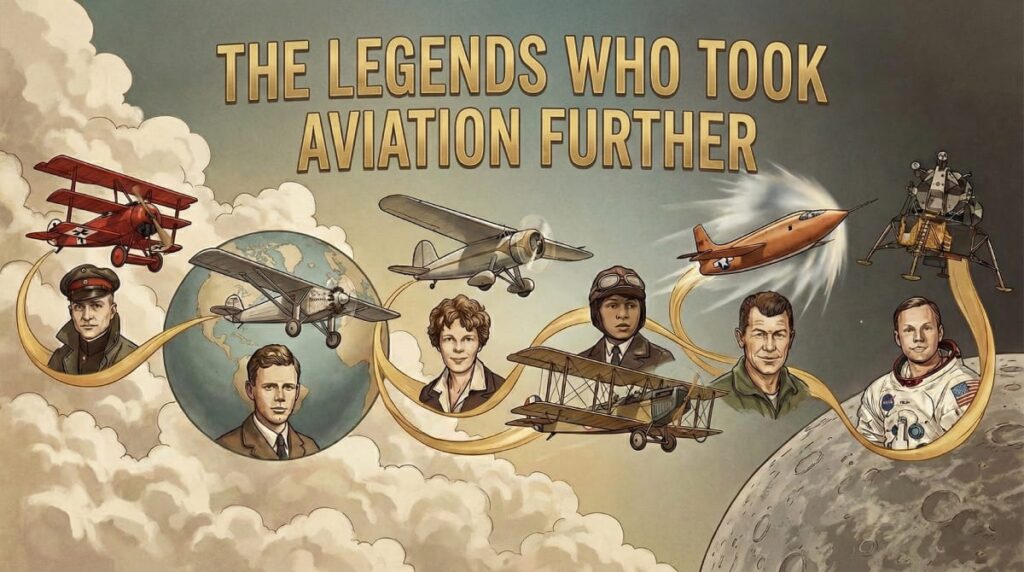

There are aircraft, and then there are aircraft that change everything. Not just the routes they flew or the passengers they carried — but the entire idea of what commercial aviation could be. I’ve spent enough time around flight decks and logbooks to know that every era of aviation has its defining machine. These are the ones that mattered most.
The Douglas DC-3 — The Plane That Made Airlines Viable
Before the Douglas DC-3, airlines were barely surviving. Most carriers depended on government mail contracts to stay solvent. The DC-3 changed that equation entirely when it entered service in 1936. It was the first aircraft that could turn a profit carrying passengers alone — and that single fact reshaped the entire industry.
It carried 21 passengers, cruised at around 207 mph, and was robust enough to operate in conditions that grounded lesser aircraft. By 1939, DC-3s were carrying 90% of the world’s airline passengers. Pilots loved it for its honest handling. Airlines loved it for its economics. And passengers — many flying for the first time — trusted it in a way they hadn’t trusted any aircraft before.
The DC-3 didn’t just open commercial aviation. It proved it could survive on its own terms.
The Boeing 707 — When Jets Changed Everything
If the DC-3 built the foundation, the Boeing 707 blew the roof off. When it entered commercial service with Pan American World Airways in 1958, it didn’t just introduce the jet age — it compressed the world. London to New York in under eight hours. That was almost incomprehensible to a generation that had grown up watching propeller-driven transatlantic crossings take the better part of a day.
The 707 set the template for every large commercial jet that followed. Swept wings. Podded engines. A pressurized cabin at altitude. Boeing essentially wrote the design language that Airbus, and Boeing itself, would follow for the next six decades. Flying a 737 or an A320 today, you’re still operating within the conceptual framework the 707 established.
It also created a generation of jet-rated airline pilots almost overnight — a training challenge the industry had never faced at that scale before.
The Boeing 747 — The Plane That Democratized Air Travel
Nothing in aviation history opened the skies to ordinary people quite like the Boeing 747. When it first flew commercially in 1970, its sheer size was almost absurd. Nearly 500 seats. A upper deck that felt more like a lounge than a cockpit anteroom. Wing loading and engine power figures that demanded entirely new ground handling infrastructure at airports worldwide.
But the economics were the real story. More seats meant lower per-seat costs. Lower costs meant lower fares. And lower fares meant that flying — once reserved for the wealthy or the business elite — became something families could actually afford. The 747 is the reason your parents or grandparents first stepped onto a plane. It democratized the sky in a way no aircraft had before or has since.
For those of us who’ve had the privilege of seeing a 747 on final, there’s nothing quite like it. That silhouette — the hump, the sheer wingspan — still stops people on the observation deck.
Concorde — The One That Flew Too Far Ahead
The Concorde was, depending on who you ask, either the greatest achievement in commercial aviation or its most spectacular overreach. Probably both. Mach 2 cruise speed. An altitude of 60,000 feet — high enough to see the curvature of the earth. Transatlantic crossings in three and a half hours.
It entered service in 1976 with Air France and British Airways and retired in 2003. In between, it carried heads of state, celebrities, and anyone wealthy enough to pay the fare — which, adjusted for today’s prices, could exceed $10,000 for a one-way ticket. Only 14 were ever built for commercial service.
What Concorde proved, beyond its engineering achievement, is that speed alone isn’t enough to sustain a commercial program. The economics never scaled. The sonic boom restricted it to oceanic routes. And when Air France Flight 4590 crashed on departure from Paris in 2000, public confidence — already fragile — never fully recovered.
Still. Mach 2. At 60,000 feet. You have to respect what that meant.
What These Aircraft Left Behind
Each of these machines left something beyond a production run or a retirement ceremony. They left a way of thinking — about range, about economics, about what passengers deserved and what pilots could be asked to manage. The aviation world we operate in today was built on the lessons, both triumphant and hard-learned, that these aircraft taught us.
For pilots and enthusiasts who feel that connection to aviation history deeply, it never quite stays in the history books — it shows up in the aircraft artwork and aviation memorabilia people keep in their offices and hangars, in the stories passed between pilots at FBOs, and in the way certain aircraft names still carry weight decades after their last flight.
Frequently Asked Questions
Q: What was the first aircraft to make commercial aviation profitable? A: The Douglas DC-3, which entered service in 1936, is widely credited as the first aircraft that allowed airlines to turn a profit carrying passengers rather than relying solely on mail contracts.
Q: Why was the Boeing 747 so significant for commercial aviation? A: The 747’s size dramatically reduced per-seat operating costs, which allowed airlines to lower ticket prices and make air travel accessible to a much broader segment of the population for the first time.
Q: Why did Concorde stop flying? A: A combination of factors ended Concorde’s commercial life — high operating costs, restricted routes due to sonic boom regulations, the psychological impact of the 2000 crash, and declining passenger numbers after 9/11 made the program economically unsustainable.
These aircraft didn’t just move people from one place to another — they moved the entire idea of what aviation could be, and that’s a legacy no retirement can touch.