
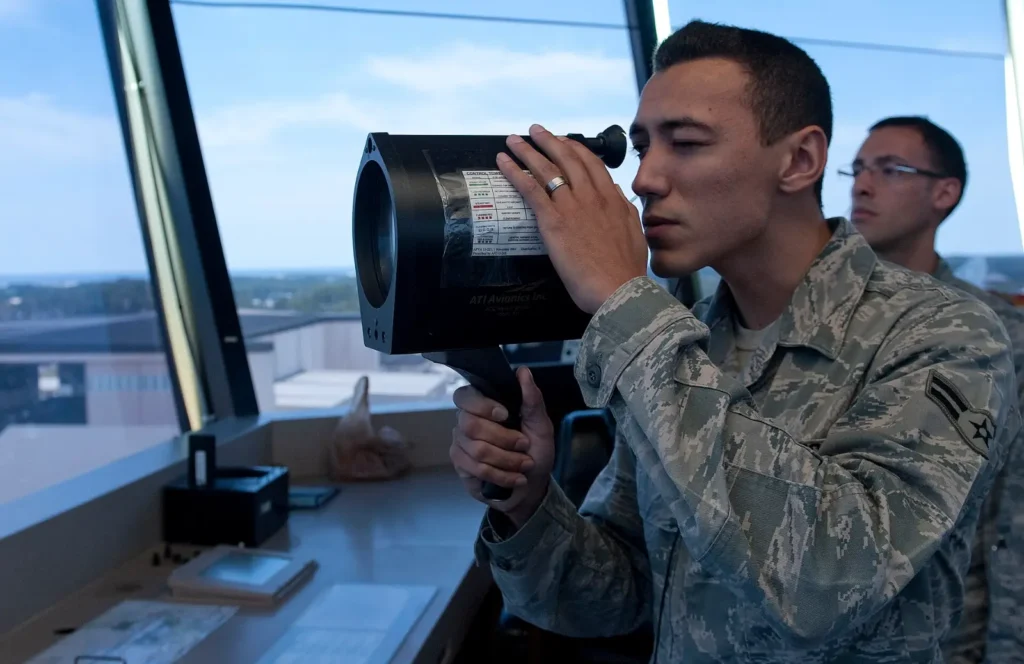
Few things get a pilot’s attention like a radio that goes quiet in the pattern. The headset is silent, the tower says nothing, and suddenly you need a plan you may never have practiced. If you fly into towered fields long enough, a radio failure is a question of when, not if. Light gun signals are the tower’s answer, and every pilot should know them cold.
What Light Gun Signals Actually Are
A light gun is a handheld signaling lamp in the control tower that can project a steady or flashing beam in green, red, or white. Controllers use it when an aircraft cannot talk to them, whether from a dead transmitter, a failed receiver, or an airplane that never had a radio. The signals are laid out in 14 CFR 91.125 and in the Aeronautical Information Manual, and the meaning depends on whether you are in the air or on the ground.
Signals for Aircraft in Flight
These are the ones I would want memorized before any cross-country:
- Steady green: cleared to land.
- Flashing green: return for landing, which will be followed by a steady green when it is your turn.
- Steady red: give way to other aircraft and continue circling.
- Flashing red: airport unsafe, do not land.
- Alternating red and green: exercise extreme caution.
The one people mix up is flashing green. It does not mean you can land right now. It means come back and set up, and the controller will clear you when the runway is yours.
Signals for Aircraft on the Ground
On the surface the colors shift meaning slightly:
- Steady green: cleared for takeoff.
- Flashing green: cleared to taxi.
- Steady red: stop.
- Flashing red: taxi clear of the runway in use.
- Flashing white: return to your starting point on the airport.
- Alternating red and green: exercise extreme caution.
Notice that flashing white has no in-flight meaning. If you see white while airborne, treat it as unusual and stay cautious rather than guessing.
How to Acknowledge the Tower
A signal does no good if the controller does not know you saw it. In flight during the day, rock your wings. At night, flash your landing or navigation lights. On the ground during the day, move the ailerons or rudder, and at night flash the landing or navigation lights. Acknowledge every signal, because the controller is watching for that response before moving on to the next step.
What I Do When the Radio Goes Quiet
Before leaning on the tower, I work the problem the way I was taught. I check the volume and squelch, confirm the right frequency, look at the headset plug, and try the other audio panel setting. Many “failures” turn out to be a loose jack or a bumped knob. If nothing works, I use a few simple habits:
- Squawk 7600 if I have a transponder. I wrote about the other emergency codes in The 3 Must-Know Aircraft Emergency Squawk Codes For Pilots.
- Keep transmitting my intentions, since the tower may still hear me even if I cannot hear them.
- Stay out of the way, fly at a safe distance from the field, and watch the tower for the light.
- Remember that I may be the only airplane in the area with a problem, so I keep my scan outside the cockpit and my traffic awareness high.
If I know before departure that the radio is flaky, I call ahead by phone when possible and arrange to arrive without radio. That conversation is much calmer on the ground than in the pattern.
Why Practicing Beats Reading
Knowing the colors on paper and recognizing them from a cockpit are different skills. Sun glare, a busy field, and the stress of a failed radio all make the signal harder to read. Ask your instructor to talk you through a simulated no-radio arrival, or review the chart with another pilot until the answers come without thinking. Good habits around radios also help, and my guide to radio calls at uncontrolled airports and the list of 40 must-know pilot-ATC radio phrases cover what normal communication should sound like, so abnormal is easier to spot.
It also helps to decide your plan in advance. Writing a no-radio response into your personal minimums means you will not be inventing a procedure at pattern altitude with a busy airport below you.
Bottom Line
Light gun signals are a simple system: green means go, red means stop or give way, and white on the ground means return to where you started. Memorize the in-flight and ground versions, remember to acknowledge by rocking your wings or flashing your lights, and verify specifics against the current AIM and 14 CFR 91.125 before you rely on them. A radio failure is manageable when you have already thought it through, so spend ten minutes this week running the scenario in your head.

