

Some aircraft earn fame because of what they achieved. Others become legendary because of what they never got to finish. Amelia Earhart’s Lockheed Electra sits squarely in that second category. It’s not just an airplane. It’s a question that never closed, a story that refuses to settle.
Spend time around aviation people and you’ll hear her name spoken with a certain tone. Not celebrity admiration. More like respect mixed with unease. Because the machine she flew, and the flight she vanished on, still feel unfinished.
The Lockheed Electra wasn’t glamorous. It was serious.
Earhart’s aircraft was a Lockheed Model 10-E Electra. Twin-engine, all-metal, low-wing monoplane. On paper, it was a sensible choice for long-distance flying. Good range for its time. Reliable Pratt & Whitney engines. Strong structure. It wasn’t experimental or fragile. It was practical.
That’s what makes it so compelling.
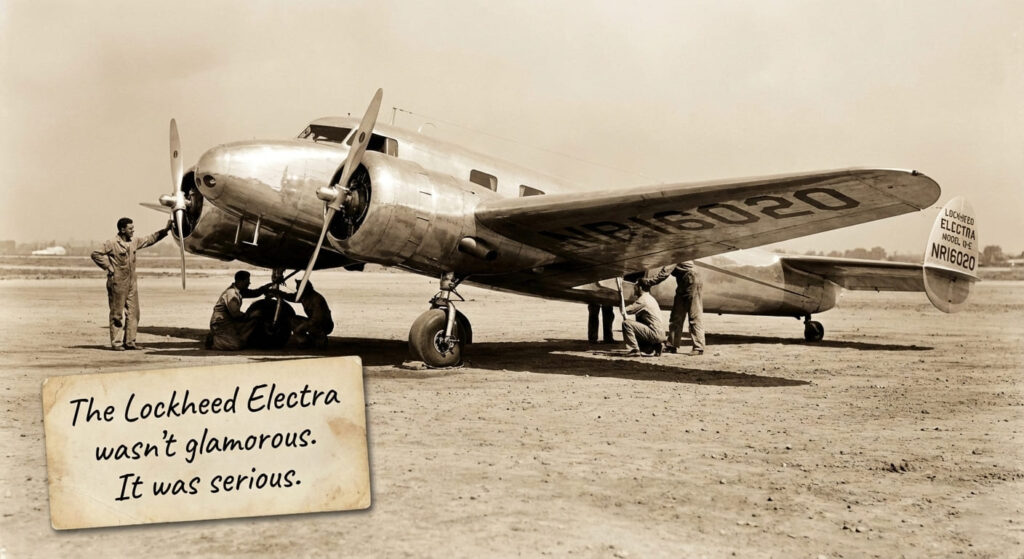
This wasn’t a daredevil perched in a barely-flying contraption. This was a disciplined pilot flying a serious aircraft on an ambitious route. The Electra had been modified for her round-the-world attempt with extra fuel tanks, navigation equipment, and weight trade-offs that made the margins thinner but the mission possible.
You can look at photos of the cockpit and see it immediately. Dense instrumentation. Functional layout. No ornamentation. This was a working airplane.
A machine built for distance, not drama
The Electra’s design reflected late-1930s aviation thinking at its best. Smooth lines. Retractable landing gear. Clean aerodynamics. It represented a shift away from fabric-and-wire aircraft toward something modern and purposeful.
Earhart’s version carried roughly 1,100 gallons of fuel. That turned a sleek transport aircraft into a long-range endurance platform. Every additional gallon brought opportunity and risk in equal measure. Heavy takeoffs. Narrow performance margins. Navigation that relied more on judgment than electronics.
There’s something deeply human about that setup. The aircraft was capable, but it demanded respect. No automation safety net. No satellite tracking. Just a pilot, a navigator, and a machine stretched to its limits.
The disappearance that froze the aircraft in time
Had Earhart completed the flight and retired the Electra quietly, it would still be an important airplane. But it likely wouldn’t carry this gravity. The disappearance over the Pacific turned the aircraft into a historical artifact before it had a chance to age naturally.
No confirmed wreckage. No final answers. Just fragments of radio messages, incomplete theories, and decades of searching.
That uncertainty does something strange. It keeps the aircraft alive in the imagination. Every generation rediscovers the story. New expeditions launch. New analysis surfaces. The Electra never becomes just another vintage airframe in a museum. It stays suspended in possibility.
Why the Electra still captivates enthusiasts
Part of the fascination is technical. The aircraft sits at a perfect intersection of old and new aviation. It’s advanced enough to feel credible for serious long-range work, yet simple enough that you can understand it by looking closely.
That’s why it resonates so strongly with collectors and historians.
A well-made model plane of Earhart’s Electra reveals details you might miss in photographs: the proportion of the nacelles, the subtle curvature of the fuselage, the purposeful stance on the ground. You start noticing how much fuel volume must’ve lived inside that airframe, how tight the cockpit must have felt on long legs, how exposed the crew really was to fatigue and uncertainty.
A custom airplane model, built with care, does more than replicate shape. It tells the story physically. You see the aircraft as a machine that had to function, not just as an icon.
More than a mystery, it’s a mirror
Amelia Earhart’s aircraft fascinates because it represents more than loss. It represents the mindset of early long-distance aviation. Calculated risk. Incomplete information. Courage without theatrics. Engineering pushed just far enough to make the mission plausible, but never guaranteed.
That’s relatable to anyone who truly understands aviation. Every flight, even now, lives somewhere between preparation and unpredictability. The Electra simply lived closer to that edge.
The airplane itself didn’t fail us by disappearing. It did exactly what aviation history often does. It left behind a machine, a trail of evidence, and a story that forces us to keep asking questions.
And maybe that’s why, nearly a century later, Amelia Earhart’s aircraft still feels present. Not as a relic. But as an unresolved conversation between ambition, engineering, and the limits of what humans can control.